This API triggers a signal to an existing running workflow. This can be used to send callback and be evaluated by the workflow to go to different next steps. Parameters can be passed along with the signal.
Input parameters
Parameter | Type | Required | Description |
|---|---|---|---|
| Number | Yes | Your account ID. |
| String | Yes | The unique identifier of the running workflow. Obtained from |
| String | Yes | The name of the signal defined in the workflow's wait step. |
| Array | No | Optional key-value pairs to pass data with the signal. |
Sample request
Given the workflow definition below and a workflow already running
name: signalDemo
steps: - name: waitStep type: wait seconds: 300 signals: - name: approve next: signalHandler - name: cancel next: signalHandler
- name: NoSignalReceived type: action action: newrelic.ingest.sendLogs version: 1 inputs: logs: - message: "no signals received" next: end
- name: signalHandler type: action action: newrelic.ingest.sendLogs version: 1 inputs: logs: - message: "signal '${{ .steps.waitStep.outputs.signalName }}' was received with: '${{ .steps.waitStep.outputs.signalInputs | tostring }}'"After starting this workflow, this runId is returned upon start 107e6df2-aa17-41bc-8065-bfa46bde810b
The workflow can then be signaled with this mutation
mutation { workflowAutomationSignalWorkflowRun( accountId: 11933347 runId: "107e6df2-aa17-41bc-8065-bfa46bde810b" signalName: "approve" signalInputs: [{ key: "foo", value: "bar" }] ) { runId }}Example log output
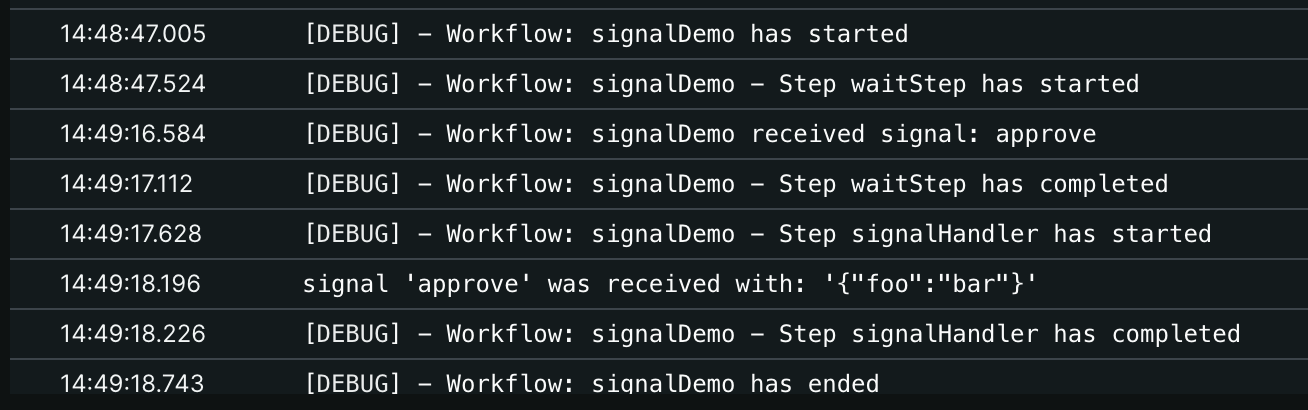
The following can be observed in the Logs if the workflow was started with the options: {logLevel: DEBUG}:
Sample response
The mutation returns:
runId: The unique identifier of the workflow run that received the signal.