• /
  • EnglishEspañolFrançais日本語한국어Português
  • 로그인지금 시작하기

Monitor Elasticsearch with OpenTelemetry

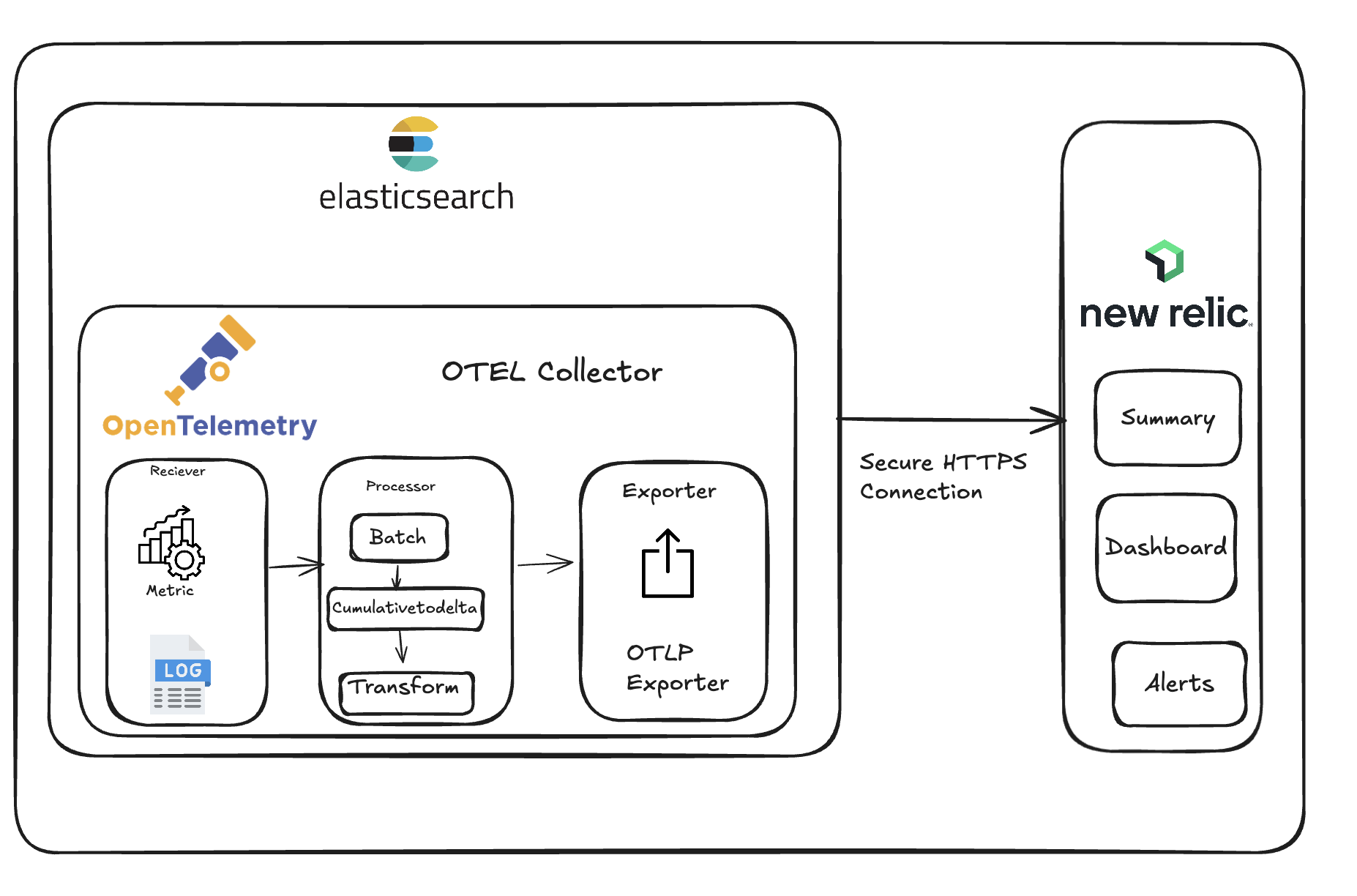
The New Relic Elasticsearch OpenTelemetry (OTel) integration provides comprehensive observability for your Elasticsearch clusters using industry-standard OpenTelemetry protocols. By leveraging the OpenTelemetry Collector, you get a unified pipeline that efficiently collects both metrics and logs from your Elasticsearch infrastructure, ensuring fast and reliable monitoring that integrates directly with New Relic.

중요

Choose your monitoring approach: This OpenTelemetry-based integration offers modern, vendor-neutral monitoring. If you prefer our traditional approach or need specific compatibility, see our standard Elasticsearch integration.

Why choose this OpenTelemetry approach?

  • Unified data collection: Single collector handles metrics, logs, and traces from Elasticsearch and host systems.
  • Vendor neutrality: Uses open-source standards that work with any observability platform - no vendor lock-in.
  • High performance: Built-in batching, compression, and cardinality reduction minimize resource impact.
  • Future-proof architecture: Built on evolving open standards that adapt as your infrastructure grows.
  • Native New Relic integration: Optimized data processing and seamless dashboard experience.

Use case: An e-commerce company uses Elasticsearch for their product search feature. Using this integration, their operations team can see if their search service is healthy, how fast searches are responding, and get notified before memory runs out - all from one dashboard. When customers start complaining about slow search results, the team can quickly see if it's an Elasticsearch problem, a server issue, or something else by viewing all their monitoring data together.

Screenshot showing Elasticsearch cluster health, performance metrics, and resource usage in New Relic dashboards

What you'll get

Monitor your Elasticsearch infrastructure with:

  • Cluster health monitoring: Track node status, shard distribution, and cluster state in real-time.
  • Performance insights: Monitor search latency, indexing rates, and JVM performance metrics.
  • Resource utilization: View CPU, memory, disk, and network usage across all nodes.
  • Proactive alerting: Get notified before issues impact your users with intelligent thresholds.
  • Full-stack correlation: Connect Elasticsearch metrics with application and infrastructure data.

Ready to get started? This integration takes about 15-20 minutes to set up. Install the Elasticsearch OpenTelemetry integration.


Key metrics at a glance

Monitor your Elasticsearch cluster health and performance with these essential metrics:

Metric category

What it measures

Priority

Cluster health

elasticsearch.cluster.health - Overall cluster status (green/yellow/red)

🔴 Critical

Shard status

elasticsearch.cluster.shards - Unassigned, relocating, or initializing shards

🔴 Critical

Node availability

elasticsearch.cluster.data_nodes - Active data nodes in cluster

🔴 Critical

JVM heap usage

jvm.memory.heap.utilization - Memory usage percentage

🔴 Critical

Search performance

elasticsearch.node.operations.time - Query and fetch latency

🟡 Important

Indexing performance

elasticsearch.node.operations.time - Index and delete operation timing

🟡 Important

Circuit breakers

elasticsearch.breaker.tripped - Memory protection triggers

🟡 Important

Resource usage

system.cpu.utilization, system.memory.usage - Host system resources

🔵 Monitoring

Complete metrics reference

The integration collects 60+ metrics across cluster, node, JVM, and host infrastructure. Expand the sections below for detailed metric specifications.

How your data is organized

When your Elasticsearch metrics are sent to New Relic, they include identifying information that helps you organize and filter your data. This metadata automatically tags every metric with your cluster information:

Tag

What it identifies

elasticsearch.cluster.name

The unique name of your Elasticsearch cluster

This cluster name tag allows you to:

  • Filter metrics by cluster when you have multiple Elasticsearch environments.
  • Create cluster-specific dashboards for production, staging, and development.
  • Set up targeted alerts for individual clusters.
  • Correlate data across different monitoring tools using the same cluster identifier.

Next steps

After reviewing the metrics and understanding what this integration provides:

  1. Install the integration - Follow the step-by-step setup guide.
  2. Set up alerts - Configure proactive monitoring for critical metrics like cluster health and heap usage.
  3. Create custom dashboards - Build views tailored to your specific Elasticsearch use cases.
  4. Explore related integrations - Consider monitoring your application stack with other OpenTelemetry integrations.
Copyright © 2026 New Relic Inc.

This site is protected by reCAPTCHA and the Google Privacy Policy and Terms of Service apply.